


Janes All The Worlds Aircraft 1953-54
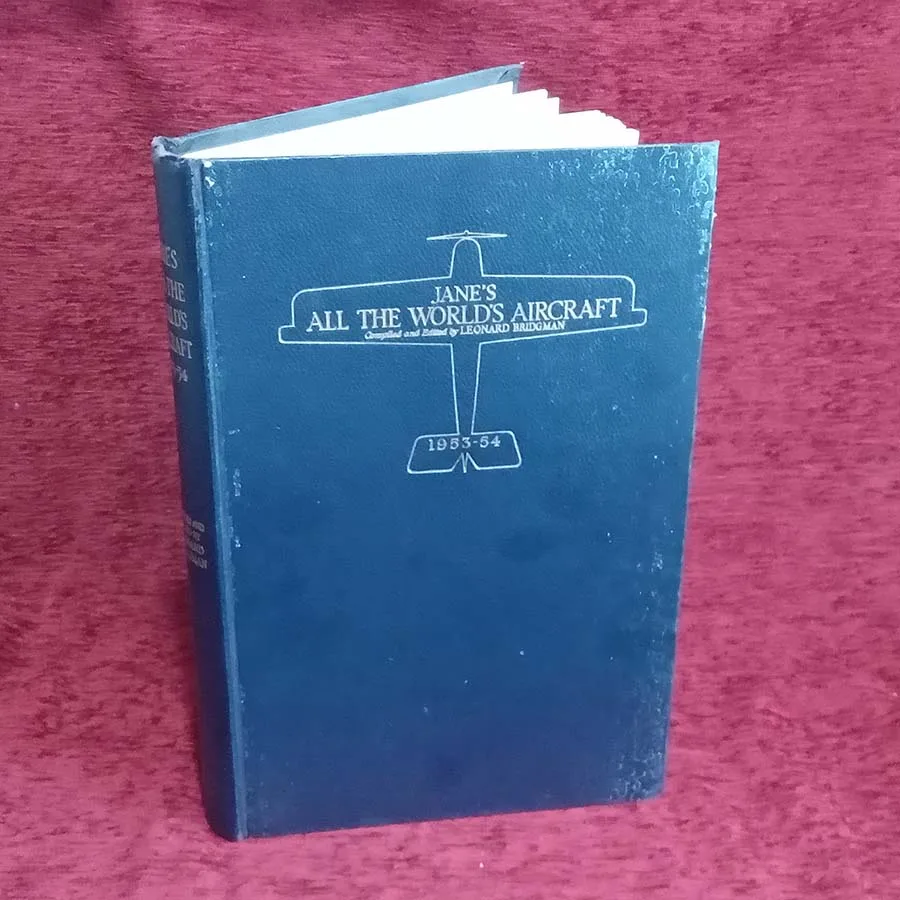
Publisher: Janes
Format: Hardback
ISBN: none
Jane’s All the World’s Aircraft 1953–54 (1953)
By Jane’s
Publisher: Jane’s — ISBN: none
Condition: Fair (ex-library)
As sold by Crappy Old Books
There are books about aeroplanes, and then there is Jane’s All the World’s Aircraft, which is less a book and more a declaration that humanity has become extremely serious about putting complicated machines into the sky. The 1953–54 edition arrives from a moment when aviation still felt thrillingly new, faintly dangerous, and impressively mechanical. Jets were beginning to dominate the horizon, propellers were not quite ready to retire with dignity, and engineers everywhere were busily discovering ever more ambitious ways to attach wings to metal tubes.
For anyone unfamiliar with the tradition, Jane’s is not the sort of publication that wastes time on romance. It is a book that looks at an aircraft and immediately asks the sensible questions: How fast? How high? How heavy? And most importantly, how many of them exist? This volume is packed with specifications, diagrams, photographs, and that glorious mid-century confidence that if something can be measured, catalogued, and printed in a tidy column, then civilisation is clearly progressing nicely.
The 1953–54 edition is particularly interesting because it captures aviation at a turning point. The world’s air forces and aircraft manufacturers were standing halfway between two eras: the heroic propeller-driven machines of the Second World War and the sleek jet age that would soon define the Cold War skies. The result is a fascinating mechanical crossroads. One page may contain a proud piston-engined workhorse, while the next introduces something that looks suspiciously like the future.
This particular copy is ex-library, which adds a layer of quiet historical dignity. Library books, after all, have lived proper lives. They have sat on reference shelves, been consulted by curious readers, perhaps even by the occasional enthusiast who wanted to settle an argument about wing span or service ceiling. The marks of that life remain here, and rather suit a book whose entire purpose is to document the practical business of aircraft design. It feels appropriate that a reference work should itself have served as a reference.
The Fair condition tells its own story as well. A volume like this was never meant to be delicate. It was built to be opened, consulted, cross-checked, and occasionally thumped shut by someone who had just confirmed a particularly satisfying technical detail. Books of this sort were tools as much as reading matter, and tools inevitably gather a few signs of work.
And what a tool it remains. Within these pages are hundreds of aircraft from around the globe — military, civil, experimental, elegant, peculiar, and occasionally downright optimistic. The engineers of the early 1950s were not afraid of bold ideas, and browsing a Jane’s volume from the period is like touring a museum of airborne ambition. Some designs would become legends. Others quietly disappeared into the long hangar of history. All of them were once taken very seriously indeed.
There is also something wonderfully reassuring about the tone of Jane’s. It approaches the world’s aircraft with calm authority, as if the skies are a large but manageable filing system. War, geopolitics, national pride, technological rivalry — all of it is distilled into tidy specifications and clear photographs. It is the bureaucratic triumph of aviation: the entire airborne world neatly indexed between two covers.
For collectors, historians, and anyone who enjoys the quiet poetry of engineering data, this 1953–54 Jane’s edition is a deeply satisfying object. Even in Fair ex-library condition, it carries enormous character and presence. It belongs on a desk where it can be opened at random, leading the reader down fascinating rabbit holes of forgotten prototypes, early jets, and sturdy mid-century aircraft whose designers believed absolutely in rivets, metal, and measurable progress.
In short, Jane’s All the World’s Aircraft 1953–54 is not merely a book about aeroplanes — it is a snapshot of a moment when the world was enthusiastically filling the skies with them. A solid, knowledgeable, slightly worn veteran of the reference shelf, and exactly the sort of thing that makes browsing old aviation books dangerously addictive. Perfect for anyone who believes that the proper response to seeing an aircraft is to immediately ask for its specifications.
Keep browsing: See more Transport books Other books by Janes
